How UV DTF Film A & B Affect Transfer Quality: A Complete Guide
Aug. 26, 2026
UV DTF is one of the fastest-growing applications in the digital printing industry. According to Bosson Research's Global UV DTF Market Research Report 2026, the global UV DTF market reached USD 215 million in 2025 and is projected to grow at a CAGR of 10.2%. A 2026 study by PW Consulting indicates that the Asia-Pacific region accounts for approximately 39% of the global UV DTF market, making it one of the world's largest production and consumption markets.
As UV DTF printer performance continues to improve, many converters still encounter issues such as incomplete graphics, missing fine lines, adhesive residue, haze or yellowing, and incomplete transfers. When these problems occur, operators often focus first on adjusting the ink, UV curing power, or lamination pressure.
Based on more than 20 years of experience in digital printing material development, Hanrun Paper has conducted extensive testing of UV DTF film structures, coating performance, adhesive compatibility, and application on different substrates. Our testing shows that the stability and compatibility of the A/B film system are among the key factors affecting final transfer quality and consistency in high-volume production.
A Film is the printable substrate used in UV DTF printing. Its structure typically consists of three layers: a release layer, an ink-receiving layer, and a base film. Among these layers, the release and ink-receiving coatings have a direct impact on print quality and transfer performance.
The primary function of the release layer is to ensure that, after printing and B Film lamination, the finished graphic can be cleanly and completely separated from A Film.
Release coatings can generally be divided into two categories:
Oil-based (solvent-based) release coating:
Provides stable release performance and controlled production costs, making it suitable for high-volume manufacturing.
Water-soluble release coating:
Offers environmental advantages, but generally comes at a higher cost and can be more sensitive to humidity.
Through strict formulation control, Hanrun Paper keeps release-force variation within ±5% from batch to batch. This helps prevent excessive release force from tearing the printed graphic or insufficient release force from causing premature separation.
According to Hanrun's release-force stability testing, the standard deviation of release force for Hanrun A Film is below 0.3 N/25 mm, compared with a commonly observed industry variation of approximately 0.5–0.8 N/25 mm.
The ink-receiving layer must be compatible with the UV-curable ink used in the printing process. If the coating and ink are not properly matched, problems such as poor ink absorption, inconsistent color reproduction, and smudging may occur.
Hanrun A Film uses a nano-scale porous ink-receiving coating with a concentrated pore-size distribution of 50–200 nm. This structure helps quickly lock in pigment particles, minimize ink-dot spreading, and support high-resolution output up to 2400 dpi, with edge sharpness improved by more than 30%.
The base film of A Film is typically made from PET (polyethylene terephthalate). Its transparency directly affects the visual depth and gloss of the finished crystal label.
Standard PET substrates typically offer a light transmittance of around 88–90%.
Hanrun A Film uses an ultra-clear PET substrate with light transmittance of up to 92–94%. Combined with UV varnish layering, this helps create the raised, glossy and three-dimensional appearance associated with premium UV DTF crystal labels.
| Performance Indicator | Standard A Film | Hanrun A Film |
|---|---|---|
| Light Transmittance | 88–90% | 92–94% |
| Haze | 2.5–3.5% | <1.5% |
| Thickness | 100–120 μm | 130 μm (High-Tack Version) |
B Film, also known as transfer or carrier film, is responsible for carrying the printed graphic from A Film to the target surface.
Its core performance characteristics include tack, release force, and flexibility.
B Film needs to provide the right level of tack.
If the tack is too low, the film may not pick up the complete graphic. If it is too high, it may interfere with the release layer of A Film or leave adhesive residue.
Hanrun Paper's B Film uses an acrylic pressure-sensitive adhesive system. Its initial tack, measured by 180° peel strength, is controlled at 6–8 N/25 mm.
This provides sufficient adhesion to securely pick up the printed graphic while allowing clean removal after application without leaving adhesive residue.
The release characteristics of B Film must be properly matched with those of A Film.
In practical terms, the adhesive force of B Film needs to be sufficiently higher than the release force of A Film so that the printed graphic transfers cleanly from A Film to the B Film.
Hanrun B Film is designed with a release-force range of 8–12 N/25 mm, while the A Film release force is controlled at approximately 3–5 N/25 mm. This creates a controlled performance difference between the two films and helps achieve complete graphic transfer with minimal missing areas.
The flexibility of B Film determines how well it can conform to curved or uneven surfaces.
Our B Film uses a low-modulus PET substrate with elongation at break of up to 120–150%. It can conform to cylindrical surfaces with a diameter of approximately 5 cm without significant wrinkling.
For outdoor applications, the adhesive layer on A Film is one of the key factors determining the service life of a UV DTF label.
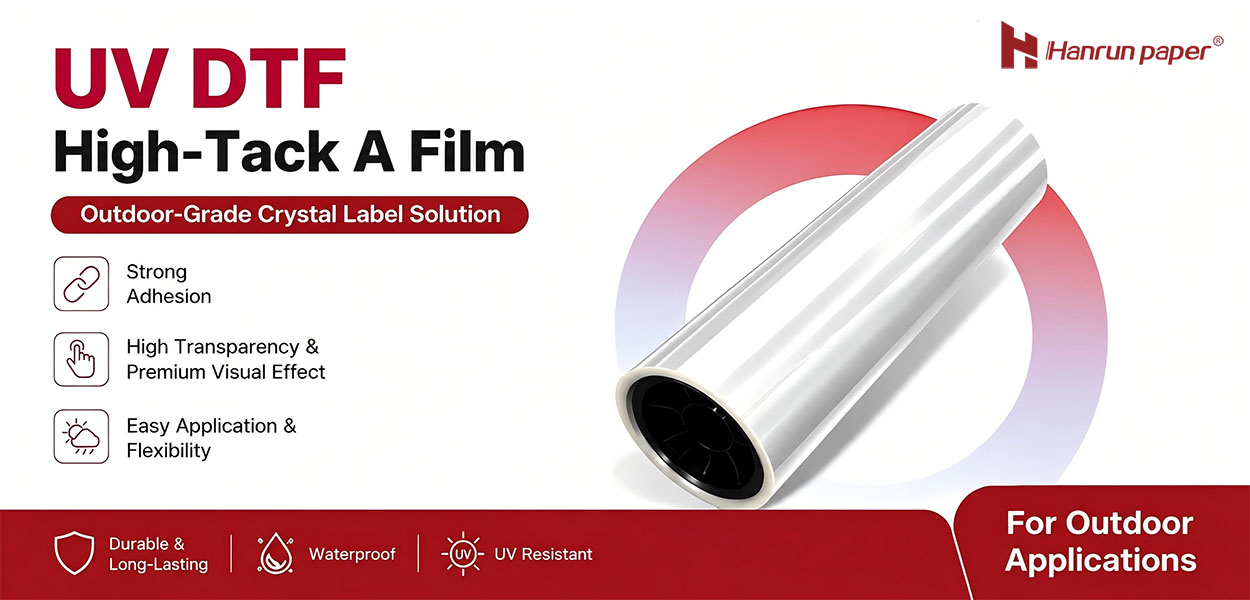
Hanrun has developed the UV DTF High-Tack A Film, featuring an upgraded high-tack adhesive system designed to achieve 5B adhesion performance.
| Test Item | Hanrun High-Tack A Film | Standard Crystal Label | Traditional Screen-Printed Label |
|---|---|---|---|
| Adhesion Grade | 5B | 2–3B | 3–4B |
| Scratch Resistance (Key Test) | No visible marks | No scratches | Slight wear |
| Alcohol Wipe Resistance (100 cycles) | No visible change | Blistering after 20 cycles | Fading after 30 cycles |
| Water Immersion (24 h) | No detachment | Edge lifting after 2 h | Blistering after 8 h |
| Outdoor Durability | No detachment or yellowing for 1 year | Edge lifting within 6 months | Fading within 1 year |
Through optimization of the polymer composite adhesive structure, Hanrun High-Tack A Film provides:
UV aging resistance:
UV absorbers are incorporated into the adhesive system. After 2,000 hours of accelerated QUV aging testing, adhesion retention remains above 85%.
Hydrolysis resistance:
A 30% increase in crosslink density helps reduce moisture penetration and minimizes adhesive failure caused by humidity.
Wide operating temperature range:
Between -20°C and 80°C, the variation in peel force remains below 15%.
Release performance affects more than peeling convenience. It can also directly influence production efficiency and yield.
Through precision coating technology, Hanrun controls A Film release force within a narrow range of 3–5 N/25 mm, helping ensure:
Manual peeling can be completed without additional tools, with a single sheet released within 10 seconds.
Automatic laminating equipment can operate consistently without film jams or film breaks.
Adhesive residue is kept below 0.1%, compared with a commonly observed industry level of approximately 0.5–1%.
| Key Indicator | What It Affects | Hanrun Performance |
|---|---|---|
| Release Force Matching | Determines transfer success | A Film: 3–5 N/25 mm; B Film: 8–12 N/25 mm |
| Adhesive Strength | Determines outdoor service life | 5B adhesion; no detachment for 1 year outdoors under specified test conditions |
| Transparency | Determines visual appearance and depth | 92–94% light transmittance; haze <1.5% |
In industrial UV DTF production, film selection should not focus on a single performance parameter. Instead, manufacturers need to evaluate the interaction between release-force matching, adhesive strength, and transparency.
Together, these three factors influence whether the graphic can be transferred completely, whether the finished product can maintain reliable long-term performance, and how the final label looks on the target surface.
With over 20 years of experience in digital printing materials, Hanrun Paper focuses on material development and application testing. Our comprehensive testing system covers release force, adhesion, weather resistance, transparency, and multi-substrate compatibility. Through continuous optimization of coatings, adhesive structures, and production processes, Hanrun UV DTF Film delivers reliable transfer performance, consistent quality, and long-term outdoor durability.
From high-transparency A Film and High-Tack A Film to precise release control and high-performance B Film systems, Hanrun Paper provides more than premium consumables. We deliver professional digital printing solutions that help customers improve efficiency, reduce waste, and achieve higher-quality, more efficient UV DTF production.
Latest News

Related Products

UV-H2513 Large Format Flatbed Printer
Four-Zone Vacuum Control System
Magnetic Levitation Linear Motor
Negative Pressure Ink Supply System
Automatic Height Detection System
High-Quality Output
One-stop UV Printing Solution

UV-H1806S Hybrid Multifunction Printer
Industrial Large-Format Output
Supports High Drop Printing
Negative Pressure Ink System
Maximum 30 mm Media Thickness Support
Automatic Height Detection System
Stable Production

UV-H1804E Hybrid Multifunction Printer
1.85-meter industrial wide-format output
Hybrid flatbed & roll-to-roll structure
Industrial-grade stability design
Professional RIP color management system
Three-zone independent vacuum system
Roll-to-Roll System

80cm printing width complete printing solution
30% lower production costs
Safe and worry-free
13-Color Printing Capability

80cm printing width complete printing solution
30% lower production costs
Safe and worry-free
Max 50m2/h under 5-color configuration

UV-H6090S Multifunctional Flatbed Printer
3*i3200-U1 high speed printing
Multicolor configuration
CCD vision positioning system
Eco-friendly and energy-saving

UV-H9060 Multifunctional Platform Lifting Printer
Maximum 50 cm material thickness
Negative pressure ink supply
Vision positioning system
Supports roll and cylindrical printing

19gsm Brown Color Sublimation Protective Tissue Paper
-Safe and Environmentally Friendly
-More Economical Solution
-Stable Quality
-Equipment Protection


Send in Inquiry
Transfer to Digital, Transfer to Future
Contact Us
+86 189 3686 5061
Address:Building 3, Yinghui Industrial Park, 129 Suyuan Avenue, Moling Subdistrict, Jiangning District, Nanjing
Navigation
Navigation